Visible Minorities: Kimi Onoda and the Trauma of History
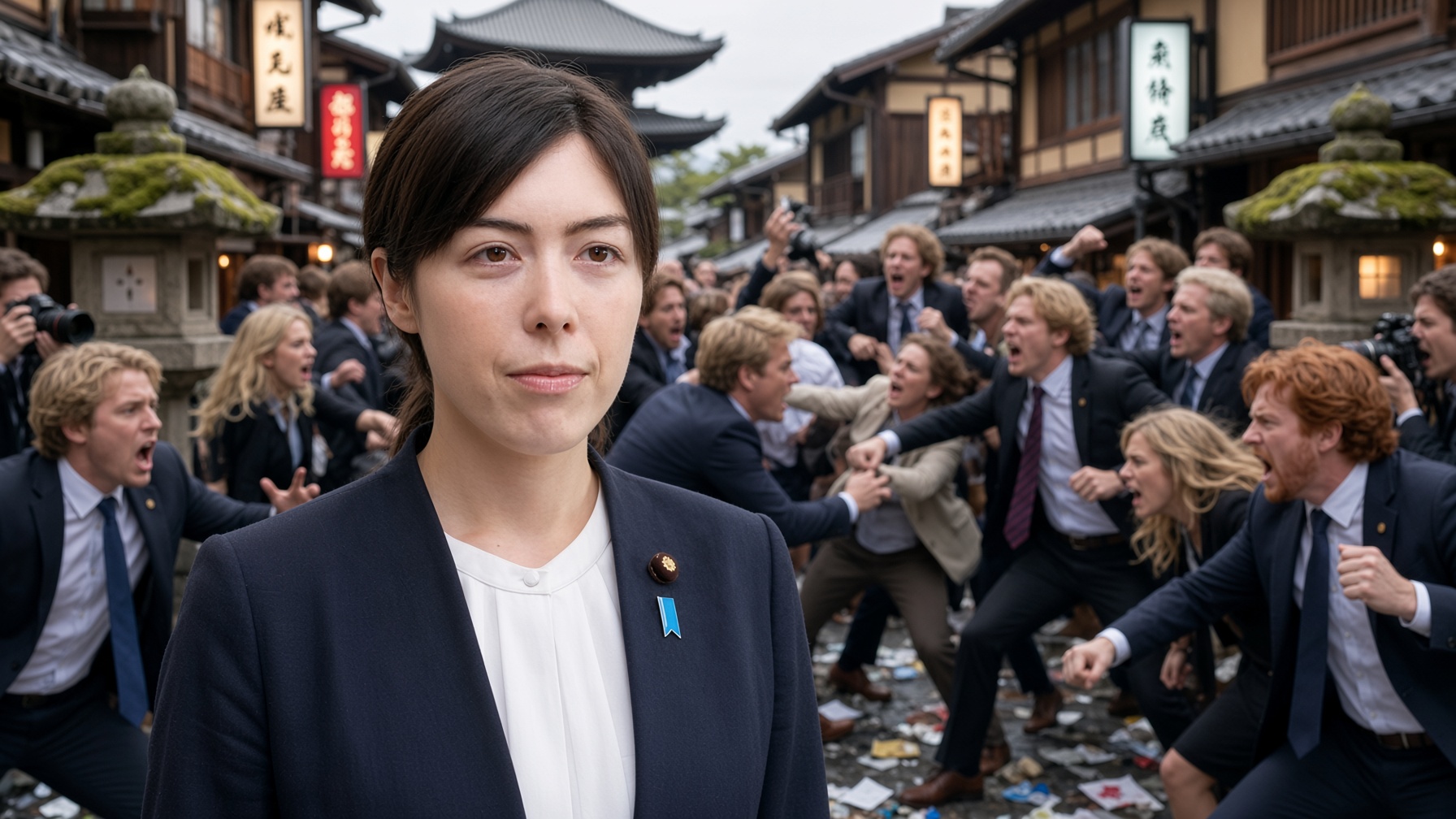
The Cabinet minister in charge of policy towards “foreigners” is basically removing them from Japan. I see it as the natural outcome of Japan’s legacy of abuse towards its Visible Minorities.
SNA (Tokyo) — Making much news in foreign quarters is Kimi Onoda, Minister for a “Society of Well-Ordered and Harmonious Coexistence with Foreign Nationals” since October 2025. She is the public face spearheading policies making it more difficult for Japan’s foreign population to stay.
Soon, foreign residents who want to live longer-term or permanently in Japan must prove that they consistently make more than the average Japanese household’s income. Even if they manage that, there will be stringent and tested Japanese language requirements, fees for visa renewals jumping more than 12-fold from 6000 yen to 75,000 yen, and Permanent Resident fees skyrocketing 20-fold to 200,000 yen.
And there’s a weird requirement, according to the Mainichi Shinbun, “that they be expected to receive a future pension comparable to that of someone who had paid into the employees’ pension system for 30 years at that income level.” Whatever that means.
Onoda is a peculiar messenger for this policy. A Chicago-born daughter of an American father, she is a subset of Japan’s Visible Minorities called a haafu (half-Japanese). As such, one might expect her to be a bit more sensitive towards other diverse Japanese, as she has faced their hardships herself. Abandoned by her father and educated in Japan’s homogenizing education system, she admits to growing up in poverty and being bullied for “looking foreign.”
However, compassion for diversity is not Onoda’s thing. She has made easily falsifiable comments about foreign crime and incarceration rates, plus defamatory claims about foreigners damaging Japanese society and the social safety net.
That nastiness is embedded in her policy justifications, claiming these revisions will prevent foreigners from becoming public welfare recipients now or in old age. (Even though that’s why everyone pays into the system in the first place.) And it was also seen when Onoda got snippy about the status of Permanent Residency (eijuken) no longer being “permanent,” pedantically saying it is not a “right” but a “permit” for foreigners. So it’s just another revocable visa. One could be forgiven for misinterpreting, since the word for “right” (ken) is embedded in the official status. Thus Onoda reveals a cruel assumption that foreigners can never truly earn the “right” to permanence no matter how long they contribute.
Finally, there’s Onoda’s disdain for accountability. According to scholar and journalist David McNeill, she lays out her policies in curt and defensive language “with little nuance… and gives every impression that she dislikes journalists.” She only holds carefully scripted press conferences, refuses to comment on questions she doesn’t like, and eschews debate or explanation about her policy positions.
Why such bile and personal animus in her public exercise of power?
While I am not a psychologist, as a columnist I can still hypothesize about Onoda’s motivations. My theory is that this is what happens when Japanese of diverse roots, bullied and scarred by their inability to fit into Japan’s “homogeneous society” narrative, become bullies themselves.
This essay will now discuss the history of Japan’s Postwar “homogeneous society” narrative, demonstrate how it stigmatized Japan’s Postwar mixed-blood Japanese children, and argue that Onoda’s bile is a product of that. Instead of showing support and solidarity for her haafu peers, she went in the other direction, overcompensating to prove herself as a “real Japanese” by pandering to the “pure-Japanese” adherents.
Japan’s Toxic Postwar “Homogeneity” Narrative
The following is adapted from my book Embedded Racism: Japan’s Visible Minorities and Racial Discrimination (Lexington Press, Second Edition), p. 43-5:
During the American Postwar Occupation (1945-52), Japan was shedding the trappings of its empire, sending its imported conquered workers back to their countries of origin, and overwriting the Greater East Asia Co-Prosperity Sphere’s narrative of “liberating fellow Asians from Western colonialism” with a “homogeneous, island-nation Japan” narrative.
But getting in the way of the “monocultural, monoethnic, pure-blooded Japan” mantra were the mixed-blood Japanese children from Japanese relationships with American soldiers. Stigmatized as byproducts of the oldest profession, these children were soon differentiated in the vernacular with labels and racialized epithets (konketsuji, ainoko, haafu, etc.).
The national government decided to address this, but did it so ham-fistedly that, according to scholar Hwaji Shin (2010), it set the template for how Japanese who “look foreign” would be treated to the present day.
Scholar Robert Fish (2009) described the government’s five-step solution as follows:
Step One: Politicians and bureaucrats drew attention to a looming “problem” (mondai) that would soon need addressing so that Japan may return to its “peaceful, tranquil homogeneous state.” Japanese society would axiomatically create problems for children who were not themselves “homogeneous” because they lacked a “pure” Japanese bloodline.
Step Two: The government drew up a policy proposal with high-level inputs from intellectuals, politicians, bureaucrats, and specialists through special deliberation councils (shingikai). The shingikai’s conclusions were on their face constructive: Make sure these children were educated properly in the Japanese school system like any other Japanese.
But the framing went awry in application: The “problems” to be resolved were riddled with negative assumptions: (a) konketsuji would bear the shame of being branded as children sired by American soldiers; (b) konketsuji would face financial hardship and stigma by being in a single-mother family of a prostitute; (c) konketsuji would not be accepted by school peers, and (d) konketsuji would be unable to function in Japanese society because they don’t “look Japanese.”
So without any scientific basis or evidence, overcautious policymakers reflexively assumed Japanese who didn’t “look Japanese” would not fit into Japan, and by saying so out loud, created an official permission structure for it to happen. As scholar Paolo Freire notes, “In order to exist, one must be named,” and branding konketsuji as a social “problem” created policies of self-fulfilling prophecy.
Step Three was the public debate institutionalizing the stigma nationwide: Politicians at all levels of government offered ponderous musings on how Japan’s “character” and “Japaneseness” would be affected by this dilution of Japan’s race/ethnicity. The contemporary media and public discourse repeatedly cited inaccurate statistics of 100,000 “children of assignations” (ainoko) and made them into a shameful reminder of the American Occupation.
The Ministry of Education even explicitly portrayed konketsuji as objects of pity, according to Fish, as children “who carry the destiny of misfortune on their backs.” This narrative spread through popular culture, including films, newspapers, memoirs, poetry, and even school speeches and essays.
In Step Four, data was collected to substantiate the anticipated outcome, then disseminated again through the mass media to officially demonstrate that konketsuji in fact did not do as well in school as their “regular” “pure-blooded” counterparts.
Finally, Step Five firmly embedded the racialized mindset into the national narrative for generations. If there were any “problems” with those children who “looked different,” they would be attributed to, yes, racism, but also just socioeconomics, difficulties fitting into Japan’s homogeneous society, being abandoned by foreign fathers, or, as the Ministry of Education officially claimed, quote, “rough personalities” from the mixed breeding.
In sum, the “Konketsuji Problem” was soon smoothed over as a postwar aberration, but by entangling it in public narratives of shame, pity, and parental irresponsibility, it created a generational environment where Visible Minorities became “Japanese with an asterisk.” It also meant, if you were outside the “normal” gene pool, you spent a life of constant psychological taxation to somehow find your way in.
Out from this toxic history steps a wounded haafu Minister Onoda.
Flawed Public Policy from Psychological Scars
Let’s pause and give some credit to Onoda: In addition to being a Visible Minority, she grew up in Okayama Prefecture, a famously conservative area that elects rabidly xenophobic diet members like Takeo Hiranuma. Nevertheless, she persisted, getting a good education in civics and getting elected to local office at age 29. She proved a quick study. Only a year later she was elected to the Diet. Within four years, she had a Cabinet post and has since served in several before getting a Cabinet position on “coexistence with foreigners” essentially designed for her.
Onoda is clearly a talented politician with a lot of future potential, only aged 43 in a system where politicians hold office well into their eighties. Her political and ideological patron, former Prime Minister Taro Aso (aged 85), is said to be grooming her for the next generation of leadership in the ruling Liberal Democratic Party (LDP).
But there has been some speculation about Onoda’s psychological scars and misanthropy. In public statements, she has said she prefers relationships in her private life only “with 2D characters” (not “3D,” as in real people). Fine, but if she only gets personally involved with fictional characters, she doesn’t face the reality of pushback or consequences from people she affects.
And that matters in a person given public power. As journalist Jake Adelstein notes, “the Overton window on immigration has clearly shifted to the dehumanizing end… 2-dimensional characters are not actually able to take care of the aged. They don’t change bedpans, nor do they do the work of construction workers, or even 7-11 clerks.”
That’s why I argue that Onoda’s apparent lack of empathy for actual human beings, coupled with a visible grievance towards the foreign side of her, makes her particularly ill-qualified to design policy for “peaceful coexistence” toward them.
Now let me speak as a Political Scientist instead of a shrink:
I believe Onoda is where she is because she is a politically convenient lightning rod. As a willing tool for ultraconservative factions, she’s helping the LDP compete for votes against the even more xenophobic “Japan First” Sanseito party by tacking further nativist right.
Essentially, as I’ve written before, she’s making herself look good by making foreigners look bad, perpetually proving to her minders that she’s “one of the good ones.”
Going in Precisely the Wrong Direction
Some caveats: First, Onoda isn’t doing this alone in a vacuum. All national-level shingikai on “international coexistence,” etc. I have ever witnessed or investigated have lacked diversity. There’s at best maybe one token foreign-born academic on their panel. And the panel’s overall attitude to their object of study is instructive: Listening to their debates, I get the impression that these councils often treat foreign residents like wild animals that have taken over Japanese housing projects and neighborhoods, with onsite reports depicted almost like a safari to an exotic land. At worst, they don’t even distinguish between foreign residents and tourists.
Point is, even before Onoda got involved, the national government usually produces public policy on foreigners without meaningful input from the people being affected by it. Blind spots abound.
Second, there’s always the argument that Japan can run its society how it likes, and if foreigners are not part of the plan, so be it. But as we have argued for decades, this is not good for Japanese society. Onoda’s policies do not defuse the demographic time bomb of Japan’s accelerating aging, depopulation, and national pension insolvency; they accelerate it. Instead of encouraging settlement, stability, and economic revitalization, Onoda’s policies are making sure foreign residents cannot be a part of it.
For example, the revised Business Manager Visa will now require current foreign business owners to provide thirty million yen in capitalization, a master’s degree, three years of business-management experience, and at least one costly full-time employee certified in Japanese Level N2. Even the whiff of this looming policy has already caused nationwide closings of shops and restaurants and an exodus of foreign business owners in recent months.
This will negatively impact the small towns and cities that are literally dying off. As the Irish Times recently reported (Sept. 9), Japan’s population has shrunk every year for the past 19 years, now a net loss of nearly 1 million people per annum. Consequently, “896 municipalities — nearly half in Japan — are facing extinction in 2040 because of population decline.”
As Adelstein puts it, “Japan’s got a bureaucracy that runs like a man who wants to lose weight, so he burns down the kitchen.” Immigration and assimilation of “new Japanese” is the clear solution, but we’re heading in precisely the opposite direction.
Third, Japan has a schizophrenic labor migration policy. Despite all the false bravado about foreign crime and all the evils that foreigners do in Japan, the LDP’s cronies have for decades demanded cheap labor and more consumers. Hence the policies that brought in foreign labor and tourists and revitalized the economy.
More of that is on the way: The plan is to more than double the foreign workers under the Specified Skilled Worker Program and to increase foreign tourism from its record 42 million in 2025 to 60 million by 2028. So all the nativists are doing is stoking their own boilers of grievance.
Finally, think of the other people with Onoda’s background in Japan. Her policies destroy whatever progress they have made. Instead of demonstrating to everyone that people who have gone through life as a haafu can still reach the highest echelons of government and be productive, loyal Japanese—that diversity is not a threat to Japanese society—she’s affirmed exactly the opposite and enshrined it in public policy.
Not only is she pulling up the ladder behind her, making it more difficult for Japan’s minorities to follow in her footsteps and assimilate, she’s helping make sure fewer feet remain to fill those footsteps.
Conclusion: Bad Blood and Bad Policy
There’s a truism in cinema: If a movie director disdains his subject, he will make a bad movie about it.
Likewise in politics: If a policymaker disdains the people she’s making policy for, she will make bad policy.
And Kimi Onoda is doing just that. Rewarded with real power after pandering to Japan’s far right, she’s using it to rid her environment of the foreign elements that have plagued her life. Her denialism not only of the reality of an internationalizing Japan, but also of her place in it, has resulted in monstrous public policies that will ethnically cleanse Japan.
Brought up in Japan’s toxic history of race relations, Onoda will only wind up perpetuating it. And Japan will continue to suffer from all the wasted potential.