Visible Minorities: “Big Garbage Day” and The Purge
It’s summertime, and the writing is easy… This month Debito feels more like writing in the voice of “Dave Aldwinckle of Sapporo” (his persona before “The Debito” took over in the early 2000s), telling a story about life in Japan in general.
SNA (Tokyo) — “Dave! Dave! Get over here! I’ve found it! The Holy Grail of ‘Big Garbage Day!’”
It was Joe ringing Dave’s keitai (mobile phone) first thing in the morning. It wasn’t the first time. It was that regular time of the year in certain parts of Japan that for some foreign residents was better than Christmas: Sodai Gomi no Hi.
That day was quite a celebration during Japan’s Bubble Era of the late 1980s-early 1990s. Anyone could find incredible Sodai Gomi, or “big garbage,” at the local neighborhood Gomi Station. Things like slightly-used stereos, TVs, consumer electronics, kitchen goods, sofas and chairs, wall hangings, light fixtures, even tatami mats. Back then, Japanese had enough disposable income to replace some items every year or so, and they didn’t have the need (or the space) to keep the old. Since there was still a general aversion to buying used goods, there wasn’t much of a market to sell it off. So out on the corner it went. Somehow the government made it disappear, for Sodai Gomi no Hi was basically “The Purge” for unwanted junk.
Nowadays, of course, it’s different. Incomes have decreased, second-hand shops have proliferated, and some governments prefer you haul big junk to a centralized disposal area. So for most dumpster divers, it’s slim pickins. But in some parts of Japan, veterans like Joe prowled on the designated days and occasionally hit the jackpot.
Today was one of those occasions. “—Dave! Are you awake yet? I need a favor.”
“First, Joe, what are you rattling on about?”
“The Holy Grail. An almost-new SONY LCD TV. But it’s too big for me to haul. And it needs cables to plug in to the wall and connect to the internet. I need you to go to Rolf’s and get them for me. I’ll text you what I need. I have to stand guard here so nobody else takes it.”
“Rolf’s. Are you sure he has—”
“Rolf is a dumpster diver like me. Get over there and I’ll get you both a case of beer.”
Ah, Rolf. A longtime professor of something, Rolf had come to Japan in the early 1990s on a Culture Visa to study Martial Arts and eventually befriended a university professor who became his employment sugar daddy. The latter’s far-afield private college wanted the prestige of a real German on the faculty roster. Decades later, Rolf, now a sexagenarian, had learned the song-and-dance of survival in an aging Japan. Thanks to a lot of beer parties and cobwebby faculty meetings, he was fluent enough to appeal to the elderly language of hopeful sloganeering, unrequited need, and general resignation. Now beyond his mandatory retirement age, he had joined the ranks of rural Japanese and their tenuous life on the edges of Japanese society.
Still, all things considered, Rolf had done well. He had acquired an entire exurban house that was itself a bit of a dumpster dive. The previous owner had been a little old widow who died in her bathtub, giving the place bad juju. “Superstitious nonsense,” said Rolf, a proudly rational German, who contentedly bought the place for a song.
Over the years he had converted his widow mansion to his little slice of home-away-from-home, filling his kitchen with bread, beer, and sausage, and converting his compact outside yard from a mausoleum of weeds into a multi-roomed greenhouse. He had jerry-rigged it out of transparent plastic and lashed-together poles from the local laundry-pole vendor, who had also retired and sold his vending truck to Rolf for yet another song. Years of unsold laundry poles were thrown in for free.
Seeing Dave arrive at his abode through the thick plastic exterior, Rolf pulled open his makeshift greenhouse door with a perfunctory greeting and offered a curt, “Moment, please.” He was furrowing his brow over a matter of great urgency. “I am watering the vegetables now. They look too thirsty. Tomatoes and carrots are so expensive in this country. Go say hi to Ingeborg.”
“Hi Dave!” she waved from a separate interior room of sorts. Ingeborg was Rolf’s southern-German partner of convenience who was easily twenty years his junior and just starting to lose her bloom. Today she was braless. After all, it was late summer, and that’s how she had always celebrated the heat—in as few layers as possible. It was her greenhouse, and nobody would tell her what to do in her own space. Nobody did, anyway. Neighbors would call by to say hello, admire the view, and make their silent mental comparisons of how Europeans are so exotic.
“Hi Ingeborg. Whatcha up to?”
“Onions. They’re very good this year!” She had already carefully excavated and laid them out on two used zabuton (a traditional Japanese flat cushion) that gave the appearance of an overloaded domino. “What brings you here today?”
“Oh, I’m here to raid Rolf’s computer cable collection. I remember he’s the type that never throws that stuff away, even if the electronics obsolesce or die. You know where he keeps them?”
She laughed and rolled her eyes. “Oh Rolf, yes, you know him well. He puts them somewhere in a closet all tied up like spaghetti. I can’t help you. I don’t know his system. Wait here with me if it’s not too hot.”
It was, but Dave didn’t mind standing by and enjoying the neighbors’ view either. Ingeborg had come to Japan on a lark during the anime wave around twenty years ago and liked it enough to stay on. But since Japanese men, too, were afraid to approach her, she found it difficult to put down roots. Luckily, she and Rolf had crossed paths through a German community which made it clear he was available. Rolf had been through a couple of Japanese marriages himself, but they soon faded once the Gaijin Groupies realized they had married a person, not a concept.
What brought Rolf and Ingeborg together beyond random circumstance was one important thing in common: loneliness for a common language. He needed someone who didn’t just question or tolerate his rationality day-in, day-out. She needed a man she could talk to without effort or games, but also needed a visa. Rolf had Permanent Residency, and so the dominoes fell into place. They married and stayed on in Japan, lashed together like sturdy laundry poles, supporting and incubating a customizably comfortable lifestyle.
“Enough heat in here for you?” barged in Rolf with a smile. Startled out of his reverie, Dave said, “Yeah, uh, hi Rolf. I’m here on a mission, actually. Joe wants some TV cables from your stash. He’s texted me exactly what he’s looking for.”
“Borrow me your phone,” Rolf said without ado, and went off to fulfill the request. Ingeborg tenuously offered Dave a beer from a cooler, but he begged off. “I have to drive soon, and you know how Japan is zero-tolerance about any alcohol in the bloodstream.”
“Yes, I understand,” laughed Ingeborg. “Can’t help you again. You know we Germans never keep non-alcohol beer in the house. What’s the point of it?”
Rolf soon came by and handed over the cables in a long-bankrupt department store bag. “What for he needs this? Has Joe found more treasure today?”
“He always does. Both of you are collectors of junk, but you know the saying about ‘another man’s treasure,’ yes?”
Rolf scoffed. “Of course I do. English is such an easy language. It’s just German from another mother. Japanese, on the other hand, is a lifetime of learning. At least the verbs come at the end.”
Rolf then beckoned Dave behind the corner of the house and to his long-abandoned neighboring house. In its driveway was parked the mostly-disused laundry-pole truck. The keys were still in the ignition, and Rolf reached in and tentatively turned the engine over. Success. Good old trustworthy Japanese cars. The windshield wipers came on and etched away accumulated detritus, and Dave smacked the cushions on the front seat to see how grimy this trip would get him. A surfeit of dust coated his hand. He would be driving with the windows down.
Dave then noticed the white megaphone speaker above the driver’s cab—the laundry-pole guy’s way of broadcasting his wares in song and message. “This still work?” asked Dave, picking up the microphone and keying it.
“Yes,” said Rolf. “Maybe you will sell something today. You have plenty of rust and dust in the back.”
“I don’t think that’s in short supply out here,” he laughed back. Dave squeezed into the truck, bidding Rolf and Ingeborg farewell via the loudspeaker as he gingerly backed out and headed for Joe’s.
An hour later, Dave had driven three towns over to Joe’s suburban neighborhood. A few blocks away from his apartment, Joe was soon spotted seated in an outdoor chair by a Gomi Station, warily eyeing curious passersby who actually had more interest in him than the TV.
Ah, Joe. He was also of Rolf’s generation, another educator who came over during the mid-Eighties to teach Eikaiwa (English conversation) and found his way into the university system by dint of a master’s degree in somesuch from an American university, but mainly the birthright of English fluency. A passionate relationship produced a Spousal Visa, keeping him from being too dependent on an employer for his lifestyle. But once Joe got Permanent Residency, he got comfortable enough in Japanese society to address his lothario itch. After all, he surmised, sleeping around in Japan is a national sport, what all his generation of Japanese men did, and once his wife had kids she didn’t much need a husband around anyway. So Joe contented himself with hobbies and womanizing while they drifted apart. Decades later, one fear he was no longer saddled with was his ex-wife’s wrath at him spending all morning at a Gomi Station, capped off by bringing more junk home.
Dave announced his presence from the truck loudspeaker, and Joe came galloping up. “Look at this amazing find!”
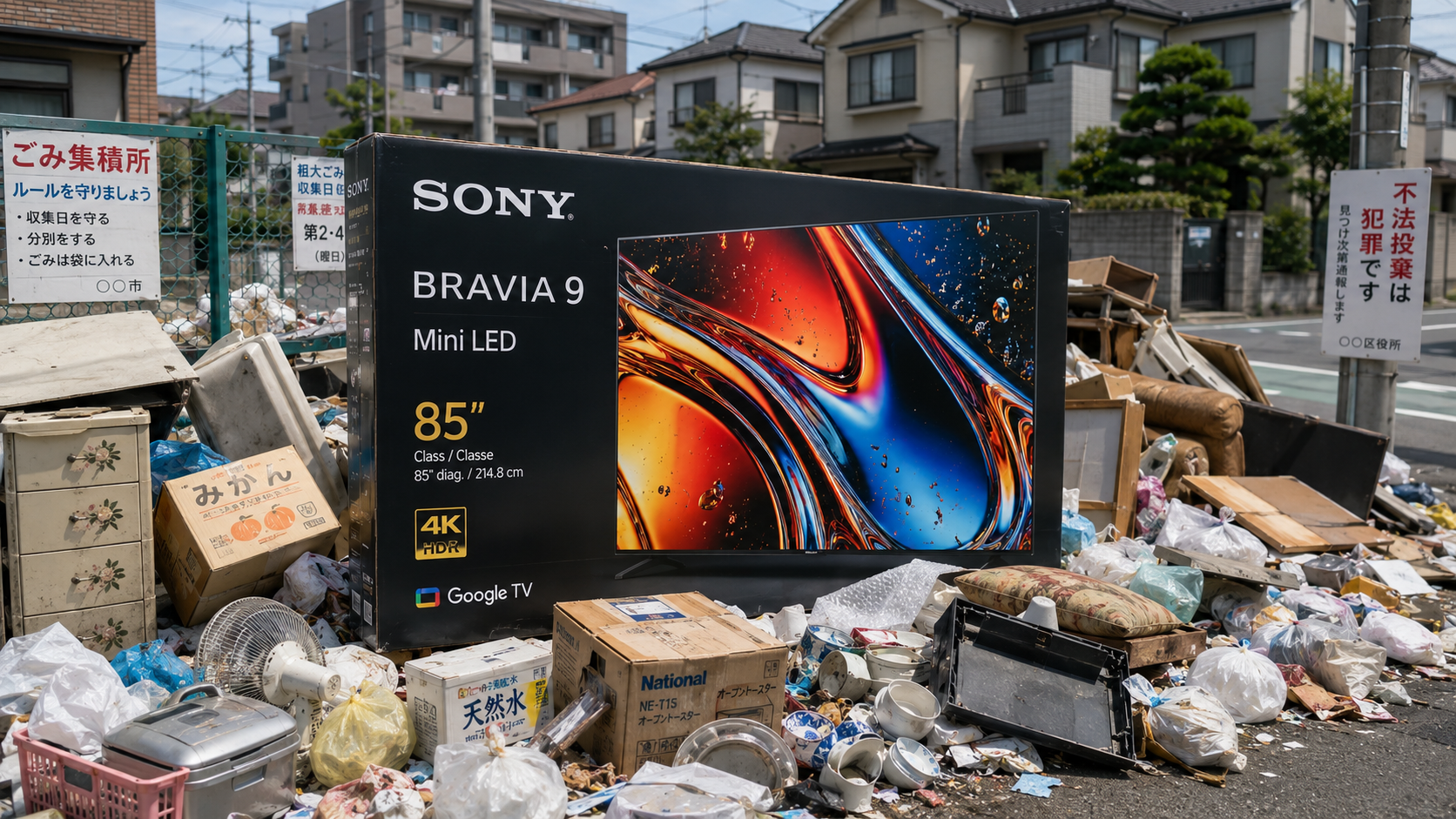
It was indeed amazing. Carefully repacked into its original box was a SONY Bravia 9 85-inch Mini LED 4K LCD TV that was barely a year old. It was worth thousands of US dollars. Why it hadn’t been taken back to the store or resold on the used market was a mystery. Perhaps the previous owner had bought it on a whim but suddenly died, and the family was summarily clearing house. Maybe some scions of the political or criminal world had offered it as tribute, so the stank of a bribe got it politely dumped with no questions asked. Or maybe it was a legacy of the twice-annual ochugen/osebo (traditional Japanese seasonal gift-giving customs) eras of yore, when people had more money than sense and gave lavish (but not necessarily wanted) gifts to superiors to maintain relationships and curry future favors. Whatever the reason, this orphaned and perhaps even unused TV was now going downmarket into Joe’s life.
“Thanks for bringing the truck. Give me a hand loading it!” Dave lifted a corner of the box and realized how surprisingly light it all was. This is true of most Japanese consumer electronics, designed light in case it falls on you during an earthquake. Nevertheless, it was expansive and bulky, as is the entire point of a wide-screen TV.
Joe jumped on the back of the truck and slid the box abreast of the truck bay wall. He hadn’t brought bungee cords, so he said he would sit in the back clutching the laundry pole racks and steadying the TV. Dave was to carefully drive the back roads to Joe’s apartment, even if that was going to annoy his GPS that was especially nagging in a Japanese voice. Hopefully they wouldn’t run into any cops, because in no way was having him ride back there legal. But Joe was willing to take the risk for both of them, of course. He was used to being looked at anyway, and he cheerily waved at giggling onlookers and passersby as if this was just the next big caper of the day on Planet Japan for Joe Gaijin.
They reached the final stage of the quest. After schlepping the box up a few flights of stairs to Joe’s bachelor pad, they contorted themselves into propping open the front door, sloughing their shoes in the tight genkan (entryway), and threading the box through the afterthought-passageway that passes for a kitchen in Japan’s 1DK apartments. In his 4.5-jo tatami room, Joe shucked the box, kicked aside his clothes and futon to make space, and plonked the TV down while he looked for one of those rare Japanese room electrical outlets. He performed triage on his long-overloaded extension cord power bar and disconnected his room lamp in the process. No worries. The TV would provide ambient light for now, even if it was only the fuzz of static. He then plugged in the TV cable, powered on, and began side-buttoning his way through the channels.
On came NHK. News desu. The image was overwhelming. The announcer’s face was already bigger than the kitchen sink, and they were sitting but a few feet away. Events in Tokyo were suddenly larger than life.
A supersized Prime Minister Takaichi was making the news for blaming foreigners for eating too much rice, thereby raising prices for the Japanese food supply. Even though, as Dave quietly knew, Takaichi herself had suspended former PM Ishiba’s program to expand rice production for export, which would have expanded the supply and brought prices down for everyone. But Japan’s rice market is not subject to market forces. It is a monopsony, where the government buys up all Japan-produced rice, sets the prices at the highest in the world, and hoards up a huge national stockpile. That stockpile was dwindling as farming families die out and fields lie fallow. But instead of allowing consumer demand to incentivize more rice growing, Takaichi was declaring a shortage and inflating rice prices. This was essentially a ruse to bribe rural areas to vote for her party by pulling levers in ways other political parties couldn’t. The downside was foreigners were once again being used as cover for Japan’s manipulative domestic politics.
Joe was relatively unconcerned about all of this. All he cared about in the moment was that he had succeeded on his mission, even if the huge TV now blocked access to his futon closet. He had an apartment to fill with stuff since he no longer had family, like so many other Japanese of his generation. And like them, he was living a life by his fingernails as his own retirement approached, when most people live the rest of their days off whatever they had accumulated during their working life.
Unfortunately, Joe and Rolf would be the last generation of foreigners that could live like their Japanese neighbors. And here’s where “The Debito” will take back the keyboard from Dave in Sapporo:
Takaichi’s new “coexistence with foreigners” policies will require future long-termers to live “self-sufficiently,” i.e., better than the average Japanese, with higher wages and pension payments, healthy and squeaky-clean lives, no bureaucratic snafus. Even though, according to the Japan Times, 61.5% of Japanese households earn less than the average (as opposed to the median) annual income. So foreigners must do even better than that.
In other words, visa rules are tightening to the point where foreign residents cannot create lives in Japan on their own terms, and are being given less leeway for learning the ropes of a complicated society and language through trial-and-error. Because any deviation from a lifestyle and a timetable set by the mandarins means foreigners get denied longer-term visas. Meanwhile, Permanent Residency is further out of reach than ever.
So foreign residents, your new marching orders are these: Pay more than average into your pensions and taxes, and hope you can hang on long enough to get anything back. But the plan is to make it harder for foreigners to stay and reap the fruits of their investments. Because “Japan First” is for “Japanese Only.” And all that Rolf’s and Joe’s successors have painstakingly accumulated in Japan will likely be lost.
In effect, Japan’s foreign residents are Sodai Gomi personified.
If you want more essays in this relaxed vein, go to Debito.org’s archive at https://www.debito.org/residentspage.html.