
Visible Minorities: Cornell University and Rape Culture
An under-investigated rape case at Cornell recently resurfaced due to a lawsuit. It might seem odd for an Ivy League school to face such severe allegations, but not to me. I was an undergraduate at Cornell 40 years ago, and what’s happening now is all within character.
SNA (Tokyo) — A media storm in recent weeks has been over an alleged rape case at Cornell University, where a lawsuit by “Jane Doe” claims that two years ago her intoxicated group sex at a frat house turned into a drug-incapacitated assault by seven men, including an invitation to more assaulters through a group chat.
The allegations become more horrifying the more one reads, but I’ll stop there. I hope an investigation by New York state authorities (not just Cornell or Tompkins County, who clearly botched things) provides justice, closure, and remedies — not to mention a revision to a vague New York state law on intoxication and sexual consent.
But this column is not to litigate the case. It is to provide some insights as to why it happened at Cornell.
I attended Cornell as an undergraduate from 1983, graduating in 1987. And the Jane Doe Case is not surprising to me. Granted, sexualized violence is a problem across American universities, but I will argue that Cornell is particularly susceptible to it. Not only is it cold, cruel, and cutthroat, but also you feel like you can get away with anything because nobody cares.
Cornell’s Remoteness and Cabin Fever
First, consider this apocryphal story about founder Ezra Cornell: When he announced in 1868 that Cornell’s motto would be, “I would found an institution where any person can find instruction in any study,” people apparently said, “You can’t say that. We won’t have the capacity for everyone.” Ezra is said to have replied, “But wait and see where I’m going to put it.”
Compared to the other mostly-coastal Ivy League institutions, Cornell is located far inland in Upstate New York in the small town of Ithaca, four hours in good weather from the nearest major metropolitan city, New York. (The only other Ivy as far inland, Dartmouth, is two hours from Boston.)
For some, remoteness is a boon: Fewer distractions mean more focused research. But for bright, restless, and randy undergraduates getting their first taste of unsupervised freedom, Ithaca becomes a small town with quite a few bored big-city trust-fund kids from Downstate.
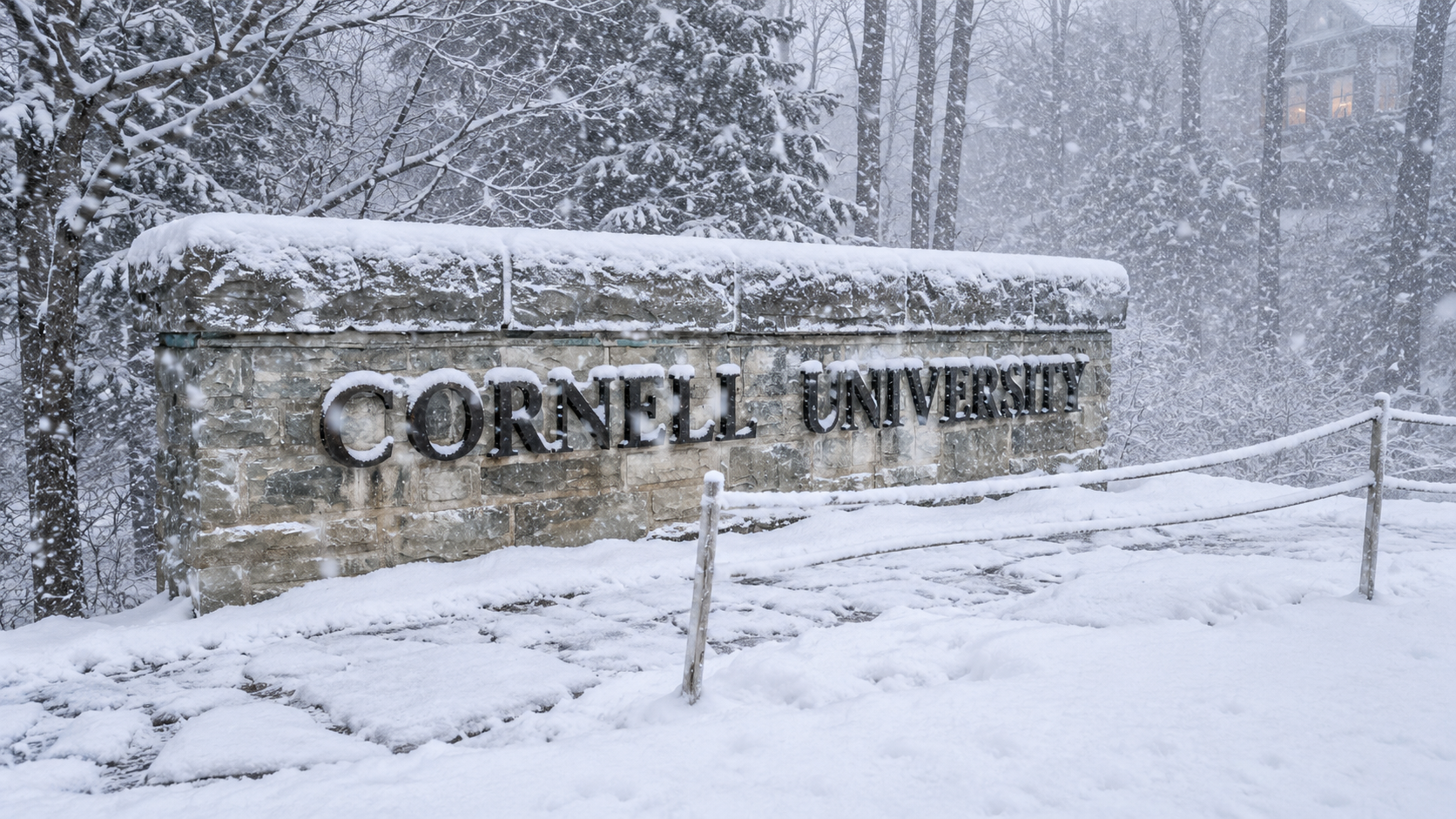
Now add in the climate. Upstate New York between November and April has oppressively grey skies, bone-chilling temperatures, and lake-effect snow howling in. Cabin fever is a thing. So much so that the university offers a daily bus service (17 round-trip routes per week, with waiting lists) to and from Manhattan. Want an image of life on campus? Listen to Simon and Garfunkel’s “I Am a Rock,” an ode to angsty English majors. To many it was an anthem.
Fortunately, I was a “townie,” galvanized by winters in high school at another small town fifty miles north. It was poorer, less cosmopolitan, and the weather worse. Cornell was a step up, and I wanted to find other people who were quirky, intellectually curious, and believed in the value of an education as an end in itself. I did, but even with all that Upstate experience, my first two semesters were simply awful. This was because Cornell students and faculty are pretty cruel to each other.
Cornell is Not a Nice Place
Start with the chip on the shoulder. Cornell is considered a lower-tier Ivy — a place where people grit their teeth about not getting into Harvard, Princeton, or Yale, and spend the rest of their lives proving that they are just as good. (For the record, they are.) I’ve attended many Cornell functions and even a summer class reunion since graduation, and even as we approach retirement, people from my Reagan-Era class spend most conversations preening about how successful they are. At the University of Hawai’i I’ve even heard them called “the Cornell Mafia” for reasons unclear.
Cornellians’ insecurity and hypercompetitiveness start in undergrad. Cornell as an institution prioritizes research over teaching, churning out world-class grad students, publications, and professors. But basically undergraduates are treated as an afterthought, a moneymaker. I only realized, after working at teaching-focused colleges and universities, just how unsupported as students we had been.
For example, let’s start with the roller-coaster of first-year introductory classes, where you find yourself adrift in an impersonal sea of hundreds of people. Psych 101, the biggest, famously had 1,600 students each semester. And they pile on the work. In the social sciences, professors routinely assigned a hundred pages or more of reading per week, times four or five classes. One week in and you felt like you were a month behind.
Big impersonal classes might be par for the course for big universities, but Cornell classroom environments went the extra mile to be cutthroat. Professors themselves sometimes encouraged sink-or-swim, survival-of-the-fittest mentalities. I heard about a professor announcing that his intro class was being curved to a C — despite the major requiring a B average. Then he added, “Look to your left. Now look to your right. Those people will probably not be in this class by the end of the semester.”
That assumes the professor actually taught the class. For example, a Nobel Laureate my classmate had made it clear that teaching students was beneath his personal schedule; students were to call his secretary to confirm if he would lecture next class. Even famed astronomer Carl Sagan was infamous for not bothering with undergraduates, sometimes so busy that students sat in a lecture hall and watched him on video. Well worth Cornell’s high tuition.
Then, if you were brave enough to ask a question, classmates made you feel stupid for holding up the lecture by scoffing, or even hissing! (The collective “Cornell Hiss” is a defining experience.) You quickly learned that questions and discussion were reserved for biweekly sections fobbed off on grad-student Teaching Assistants (TAs), who weren’t teachers either. Some were there to scoff at your questions too. Others had difficulty speaking English!
That meant that for the first two years of required foundational courses, at best you were getting detached lectures from a world-famous researcher, at worst winding up with a low grade at the end of the semester because you got a bad TA.
Students soon became sociopathic. I heard about a TA having students submit their weekly problem sets in a box outside their office. That soon stopped because students were taking submissions out of the box and putting in wrong answers. Why? To lower the curve for the class.
Other students turned self-destructive. Security was beefed up around the campus gorges at “prelim” (midterm) time, because class brainiacs effortlessly getting As in high school were suddenly coping with Cs, Ds, and Fs and thinking their lives were ruined. And suicide is more tempting when you see the “easy-out” solution every day walking to and from class.
To be sure, weathering shocks is part of the college experience and growing up. But there are better ways to do it than in the Cornell Crucible. At the teaching universities I work at we tell students about the “hidden curriculum” of college. For example, reading your syllabus in advance to assess how organized or maniacal the professor is. Or knowing what office hours are for. (I only started going to them in Sophomore year, but even then at Cornell you might get five minutes, timed, with a world-class professor bored with intro-level content. Or, again, just get the TA.)
Or going to the writing center for help on getting your papers up to an academic standard. Or asking a librarian how to find books or use a card catalog. (We had no Internet yet.) Or availing ourselves of mental health counseling on campus (although back then psychiatric help was a bit stigmatized, ridiculed as Woody-Allen hypochondria). Or knowing that there is someone called an Ombudsman to mediate any grade disputes with TAs. And of course, knowing where to go or what to do if you are sexually assaulted.
At Cornell the attitude was more, “These are all things you have to live and learn through.”
For example, one of our first Cornell lectures was from legendary Professor L. Pierce Williams, who offered his “Notorious Note-Taking Lecture” every Orientation. It humorously had nothing to do with note-taking. After dwelling on how Cornellians develop quirky research passions (like bombardier beetles), the upshot was that Cornell was an ordeal to attend; it would break you down and hopefully build you back up again.
Still, in all Williams’ humorous asides, students were still not told about the tools to empower themselves. Such as how to take notes. (I didn’t even know there was something called the “Cornell Note Taking System” until I was in my forties!) And, aside from Psych 101’s mid-semester module on the deleterious effects of sleep deprivation, insufficient heed was paid to students’ physical and mental health. Cornell was toughening you up for the real world where you grab what you want.
Sing it with me: “I am a rock. I am an island.”
No Rest from the Ordeal
But the ordeal went beyond the classroom. I got unlucky my first semester, crammed between four walls with a bad roommate in a room meant to be a single, and not in the worn-out lower-campus “U-Halls” that Freshmen got thrown into and spent the year trying to get out of. I was “lucky” enough in the campus lottery to get a dorm in the Collegetown bar district, filled with upperclassmen because they were still legal to drink.
Cornell upperclassmen take a certain delight at watching Freshmen flail. That’s how they were treated, now it’s somebody else’s turn. To ingratiate ourselves we were constantly apologizing for our learning curve. And then the cycle perpetuates next year when we can haze downward.
That’s what happens when Cornell lacks the undergraduate residential colleges at places like Princeton or Harvard, designed to foster tight-knit mini-communities and support each other’s same-age experiences. (Al Gore and Tommy Lee Jones were famously roommates at Harvard for all four years.) At Cornell, people are cold by living space design.
And then comes the winter hunker-down, where your pastimes turn hedonistic. Once Upstate’s amazing fall colors blow away around Halloween, the darkness sets in for six months. You find pastimes, but soon realize that there’s not much else to do in winter but eat (Cornell Dining is excellent), go to the library, find friends (or have superficial “Face Time” events), or find a comfortable place to rest your head (not guaranteed; Ithaca has slumlords so predatory we knew them by name).
That’s what makes Cornell fraternities and sororities attractive to some. They are housed in beautiful multistory mansions just off campus, built by actors and producers when Ithaca was the silent-film-era “Hollywood of the East.” Largely left to their own devices, young, isolated, minimally supervised, and often rich and entitled males find themselves steeped in National Lampoon’s “frat-boy humor” and destructive Animal House culture (one tagline of the 1978 movie: “We can do anything we want. We’re college students!”). At many universities they are generally excused for their campus japes and pranks, if not encouraged by a forgiving “boys-will-be-boys” environment. (It’s called “himpathy” by scholars.) At Cornell, stir-crazy students party and pork. It’s been nicknamed “Carnal University” for a reason.
Cornell frats have a long history of excess and violations of the Student Code of Conduct. Delta Kappa Epsilon (a motto I once saw outside one of their parties: “DKE till you drop”) has gotten itself in trouble multiple times for excessive drinking. Phi Kappa Psi, Phi Sigma Kappa, Delta Phi, Theta Tau, and Zeta Psi have dangerous and deadly hazing. According to Cornell’s official website on this, most semesters listed since 2004 have reported multiple violators.
I personally rushed two frats, but soon stopped because the atmosphere felt off. One evening during my first semester, my Freshman neighbor from my Collegetown dorm got carried in after a frat party. Despite being underage, he had blacked out, which the brothers thought was raucous. They dumped him in our dorm’s communal bathroom and left him for dead. Our RA asked us to turn him on his side so he wouldn’t choke on his vomit. By morning, he had covered the entire bathroom floor with so much puke that it was seeping into the carpet next to my room. I soon moved to a different dorm.
Now let’s situate this timeline in the “rape culture” of 1980s mass media. For example, frathouse movie Animal House was so successful that it was one of the biggest box-office hits of the 1970s, listed in the Library of Congress’s National Film Registry as “culturally, historically, or aesthetically significant.” Even Roger Ebert gave it four out of four stars, and it spawned a TV spin-off and a chart song. Great. But remember that within all the movie’s hijinks, one of the goals was to get women drunk enough to bypass consent.
This percolated downward. For the high-school set, even “teenager flick” director John Hughes (famous for The Breakfast Club and Ferris Bueller’s Day Off) provided a scene in Sixteen Candles (1984), where the heartthrob character offers Anthony Michael Hall his drunk and semiconscious girlfriend and tells him to “have fun.” Hughes plays it for laughs.
There’s plenty more. Just watch more ‘80s movies. The downside is that if you laugh at or even celebrate this stuff, you create a permission structure for it. When Christine Blasey Ford accused future Supreme Court Justice Brett Kavanaugh of attempted rape, I fully believe her. Kavanaugh graduated high school the same year I did, and was steeped in the same culture.
There were counteractions to sexualized violence, then as now. “Take Back the Night” rallies raised awareness about sexual assaults on Cornell’s expansive campus grounds. They were taken seriously enough for the university to start a service where campus security officers (always in pairs, and with uniforms and identification) could be called up to walk people home. Good.
But I also heard the broskis dismissing the women protesters as “Cornell dogs” (a play on words for the local canines allowed to roam freely on campus during the 1970s), saying they were too ugly to worry about needing the service. Hilarious, guys. And indicative.
Have the Fundamentals Changed?
That’s what I saw at Cornell 40 years ago. Have things changed? It doesn’t seem so.
Let me excerpt from Cornell philosophy Professor Dr. Kate Manne’s article, “What it feels like at Cornell right now” (New York Magazine, September 29):
On Wednesday night, Cornell will bring the distinguished sociologist Cynthia Miller-Idriss to campus for a prestigious university lecture. The topic? The links between misogyny and violent extremism. But what good is this discussion if we don’t address the problems in our own backyard? What use was it to bring the writer and activist Chanel Miller to campus in the spring just for fraternity brothers to scroll, bored, on their phones as she movingly shared her experience as Emily Doe, the victim of Brock Turner?
“As I wrote at the time, I was floored and dismayed as I sat in the audience with one of my brilliant undergraduates; we heard Miller’s shattering account of being sexually assaulted by Turner behind a dumpster at Stanford University after a fraternity party. Her talk was riveting, and there was so much to learn from it. And yet many of the male students who hailed predominantly from fraternities — 15 percent of each chapter was required to be in attendance — were so tuned out that Miller commented ruefully: ‘You know, this has been my hardest gig, because they didn’t turn down the house lights. I’m not sure how you professors do it, because it’s so hard looking out at this sea of mildly disgruntled faces. I mean, I’m sure you’re all very moved, but …,’ Miller smiled. The implication being, it didn’t seem like it, from her angle.
I usually end my columns with suggestions for improvement. I can’t this time. This field isn’t my expertise.
But I do have my experience at Cornell to offer. I realized that I am capable of powering through hard times to accomplish my goals. It served me well in Japan, where adversity is seen as an inevitable, if not fortifying, part of life.
But also I see how Cornell is not (or should not be seen as) a healthy or even normal college experience. If anything, Cornell taught me how NOT to teach or treat students.
Another world is possible. Other institutions get their students through with less self-generated adversity and asshollery.
But Cornell is simply not that kind of place. It is institutionally hard-wired to be so cold and impersonal that people assume nobody’s really watching, so they can get away with being predatory. And, as usual, this works against women.
It will take experts with degrees to fix this situation. Cornell has no shortage of them. But will admin listen? Or will the next winter just swoop in and make everyone sing “I am a rock, I am an island,” all over again?
Given that 40 years have passed and I’m still not surprised by this lawsuit, I suspect the latter.
Unless there are both big changes to the law and even bigger changes to the cruel Cornell campus culture, there will be more Jane Does.