
Visible Minorities: Semiquincentennial vs. Bicentennial
The United States should be celebrating the best of itself on its landmark birthday, like it did fifty years ago. It’s not. But the party is actually elsewhere.
SNA (Tokyo) — Last month I had the priceless pleasure of getting together with my fifth-grade class in my hometown of Geneva, New York. As planned.
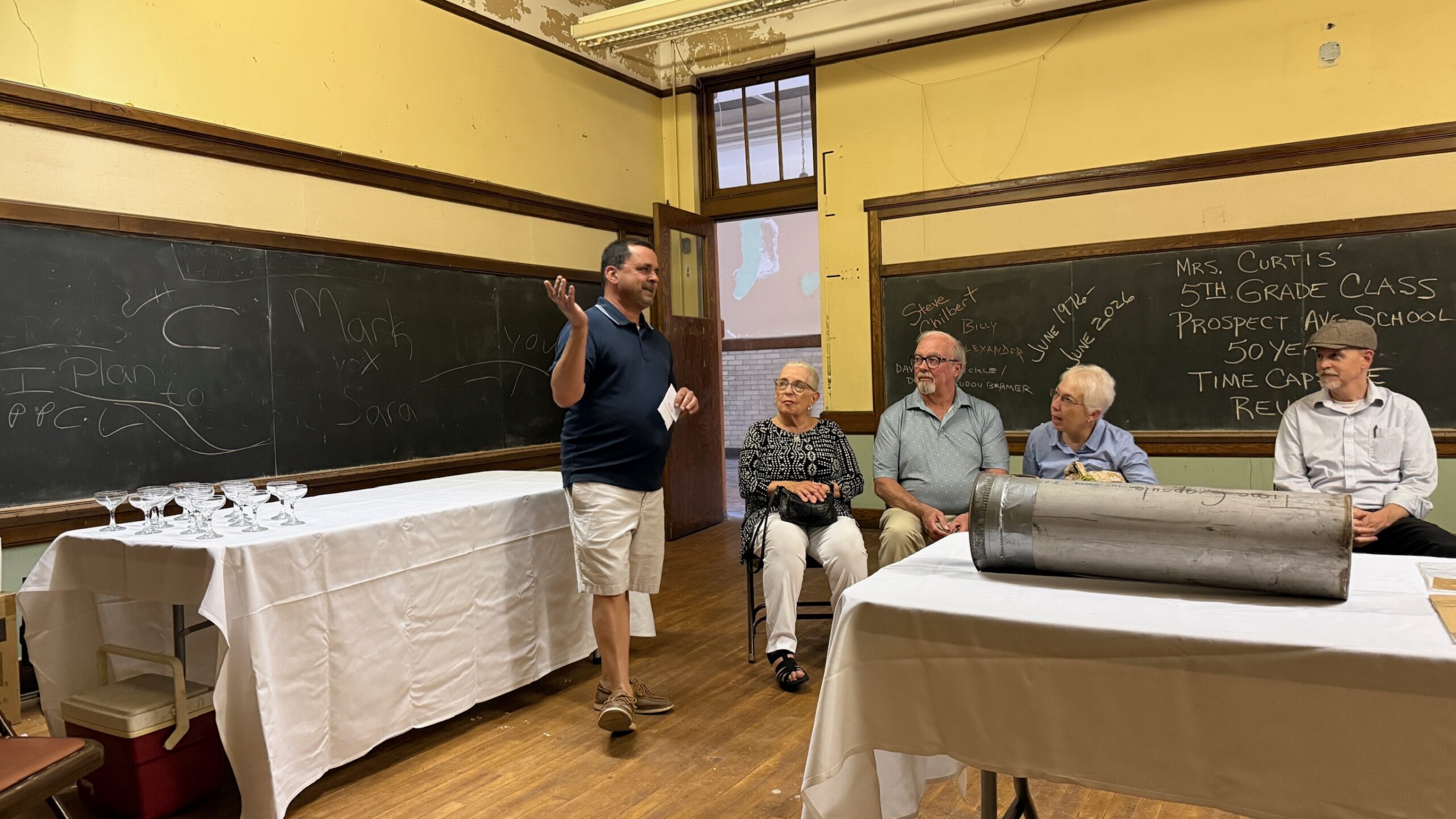
On June 25, 1976, the last day of school, our teacher, Mrs. Curtis, said we should reconvene in fifty years. Our class had just sealed a time capsule — a metal tube big enough to encapsulate a bodybuilder’s arm — and stuffed it with contemporary paraphernalia for safekeeping in our local museum. When we reached age sixty, we were to open it.
Back then we were only ten or eleven years old. Sixty seemed positively ancient, like Mrs.-Curtis-ancient.
But now here we were, our careers, investments, births and deaths, marriages and divorces, children and grandchildren, accidents and recoveries, and major life lessons behind us. Eight of our class of 22 sitting in our original classroom, completing our longest-ever homework assignment.
Opening Pandora’s Box
On June 17, 2026, we convened at our old Prospect Avenue School. Built in 1926, the building was celebrating its own centennial, but had long since been repurposed into a lodge for the local Sons and Daughters of Italy. They had left the upper floors, where our classroom was, derelict.
Turns out the classroom was a time capsule in itself. Windows boarded up and unopenable, the room was stuffy, dusty, and claustrophobic to the roughly two dozen adult family and friends who had made the pilgrimage. Peeling ceilings were glumly illuminated by the remaining original yellowed fluorescents. We were duly warned not to linger because of the asbestos, but laughed that if our years of classroom exposure hadn’t felled us yet, no worries now.
Amazingly, Mrs. Curtis’ handiwork was still there a half century later. The room’s still-functional black slate chalkboards were framed by her history timelines on the walls in black tape, designed to give even the most bored fifth grader something to absorb by osmosis. I remember the earliest date was written on a piece of construction paper in Mrs. Curtis’ elegant cursive: “1000: Leif Erikson visits America.” Fifty years later it was still there, affixed by clearly immortal scotch tape, nearly crumbling to dust at the touch. The timelines snaked around the room, ending at 1970 when our educations began.
After organizer Steve offered a few words about the significance of the event, the capsule was readied, rivets removed, and duct tape easily peeled off, and out poured an unoxidized snapshot of youthful knowledge. A sample:
A Time Magazine from June 14, 1976, unopened in its delivery wrapper. A Geneva Times front page mysteriously headlining, “Plants may produce germ weapons.” Car catalogs and newspaper Sunday comics. Images from the 1976 Winter Olympics. Advertisements for polyester clothing and milk for 49 cents a gallon. A Geneva PennySaver offering tacky hand-drawn furniture that would fill your living room for only $459. An empty Pepsi can with the old ring-pull tab attached. A profile of President Gerald Ford. A folding paper map of New York State.
Accompanying each item were classmate explanations rendered in our crude but careful cursive pencil, depicting an assumption that future America must be completely different, with flying cars, George Jetson fashions, and the metric system. One classmate put in a ruler with a careful explanation of feet and inches. Others carefully explained how zippers, pins, and needles fastened clothes. Another explained the concept of taxes, collected at multiple government levels. One mentioned how the Sunday comics were called “the funnies.”
My contributions were a current 50-star American flag and an obscure 35-star haloed medallion version I described as a “Flag of the Union” (as in the Union side of the Civil War). Turns out the flag commemorated West Virginia’s admission as an anti-slavery state in 1863, but I doubt I knew that. I was clearly a weird kid destined to dominate bar trivia games.
But I also put in something mundane: a quarter, half-dollar, and silver dollar, with a description of what dollars and cents were. But they weren’t random pocket change. They were coins specially minted to commemorate the American Bicentennial.
That’s what occasioned Mrs. Curtis’ time capsule. Nothing in it about us as students or individuals. No personal messages. No self-introductions beyond our names on a roster. The point was to interest the historians, not send a message to ourselves. To teach future America about what our America was like during a special year — America’s 200th birthday.
That brings us to the point of this column.
The American Bicentennial Was Better Done
I’m fortunate to have experienced two commemorative years for America: the Bicentennial 200th Birthday in 1976 and the Semiquincentennial 250th Birthday this year. I’m also fortunate to be a columnist with a loose deadline, so I’ll consider it my job to compare them. I’m now going to step beyond my fifth grader awareness of politics and government, and apply my knowledge as a professor of Political Science at multiple California State universities.
I can say without reservation that 1976 did it better.
From the beginning, the mood was festive. The build-up was there. I remember New Year’s Eve 1975 watching the Times Square ball dropping on TV. Just after midnight, the crowd spontaneously broke out singing “Happy Birthday” to America. Shortly after, we learned the novelty song in school, “Fifty Nifty United States,” which to this day helps us recall all fifty states in alphabetical order. We even sang it together in our classroom last month, fifty nifty years later.
Back then, Bicentennial gear was everywhere, making it easy for us kids to find stocking stuffers for the capsule: a pamphlet we plucked from some newspaper offered all the flags of American history. A beer-can piggy bank, produced by Geneva’s long-gone linchpin employer American Can, offered an image of the Founders signing the Declaration of Independence (mentioning only in passing the factory’s own 75th anniversary). All manner of media offered articles and advertisements that were star-spangled and thirteen-striped. An enclosed Reader’s Digest dated June 1976 had an article from astronaut Neil Armstrong entitled, “What America Means to Me.”
It was a happy time. But the happiness was also tempered by history. Legendary journalist Walter Cronkite signed off a 16-hour show entitled “In Celebration of US: Our Happiest Birthday” on July 4, 1976 — mere weeks after we had sealed the time capsule — where he said, poignantly:
“Well, the party’s just about over. We’re 200 years old. It’s a milestone that makes us wonder what will become of us as a nation. We’re not sure of the future. No one can be. We don’t know what’s behind the doors that we must open. We only know that the keys we have — keys cut in Independence Hall which became our ideals: liberty, justice, equality. Our people have suffered and died for those ideals. We as a nation have written a remarkable history, certainly. But we should remember that we have not fulfilled our ideals, even after 200 years. Correcting wrongs will be part of our future. It will demand courage. But correcting wrongs has been a dramatic part of our history. Courage is a remarkable part of our heritage. It can open the doors to justice for everyone. We will be alright if we keep in our hearts the story of America.”
American Democracy on the Brink on Its Birthday
Now in our 250th, the mood is very different. And I’m not so sure we will be alright.
Yes, local governments are rightly doing their commemorations, and no doubt billions will be burnt in fireworks. But at the national level, the celebration is muted. Many of the festivities are reserved for a segment of the population — the people who support the current President.
Consider the America250 bipartisan initiative launched a year ago, to “engage every American… to inspire our fellow Americans to reflect on our past, strengthen our love of country, and renew our commitment to the ideals of democracy through programs that educate, engage, and unite us as a nation. America250 will foster shared experiences that spark imagination, showcase the rich tapestry of our American stories, inspire service in our communities, honor enduring strength, and celebrate the resilience of the United States of America.” That feels like 1976.
However, it’s been hijacked by the President Trump-affiliated Freedom 250, which offers no readily found goals on its website. It has siphoned off most of America250’s budget to headline one person (himself) instead of one nation.
This year’s metaphorical time capsule has been filled with images of Washington DC, in disarray: a demolished White House with superglued gild, a violent UFC fight that tore up the Ellipse, a Kennedy Center closed to celebratory events, a profoundly unattended Great American State Fair establishing chintz and Christianity on the National Mall, the Reflecting Pool fenced off and patrolled by the National Guard, and hallowed institutions such as the National Park Foundation corrupted with suspected personal profiteering and wire fraud. Even DC’s July 4 celebrations are not about promoting inclusive narratives of “We the People,” but rather “the most spectacular TRUMP RALLY of them all.”
Cronkite’s ideals of “liberty, justice, and equality” have been overwritten with “oligarchy, corruption, and anti-Woke.”
The narrative of the Semiquincentennial is replete with White Christian Nationalist imagery and programming that showcases only part of the American story — when Americans downplayed the stain of slavery and fought to keep American power majority white. This is their reaction to America becoming inexorably browner, with the share of the foreign-born population more than tripling since 1970, and the white population decreasing from around 83% in 1976 to less than 56% today.
Hence the efforts to restore power along racial lines and ethnically cleanse the country. Since 2025, more than half a million “illegals” (including US citizens) have been deported via more than 200 deadly ICE detention centers. To stifle diverse opinions and social movements, the machinery of the federal government has been weaponized to cow the media and suppress minority votes in elections. The Department of Justice has targeted Trump’s opponents and threatened critics with lawsuits and loss of livelihood. This year’s Supreme Court rulings alone have further strengthened the powers of the executive branch while weakening voting rights and independent oversight institutions; several “textualist” justices even argued against the Constitution’s explicit text granting birthright citizenship!
America is also being narratively cleansed. “America’s story” is being sanitized from the Smithsonian on down, with the presumption that America’s diversity of voice and view is a threat, not an underlying strength. The multicultural, pluralistic society fostered by America’s “second founding” after the Civil War, with the creation of the Constitution’s 13th, 14th, and 15th Amendments, is being steadily undone.
Finally, the Constitution is being ignored, if not violated, daily, with but one example seen in the emoluments clause, as Trump has profiteered from the presidency to the point of his net worth increasing by an estimated $4.2 billion since he retook office in 2025. America’s accelerating concentration of wealth in the top 1% of income earners has produced the world’s first trillionaire in Elon Musk, while more than half of Americans are now living paycheck to paycheck. People who can’t afford the basics, due to capricious wars and high fuel costs, are grousing that the Semiquincentennial is less a vacation than a “staycation.” Party? What party?
What’s changed since 1976? The one truly revolutionary thing that nobody in Mrs. Curtis’ class could have foreseen is the internet. All the world’s information is in the palm of your hand on your smartphone, but the flip side of the coin is social media. Our attention span has been commoditized, and the tech oligarchs’ algorithms are designed to polemicize regular discourse and divide people into warring camps.
“We the People” has become “Us and Them.” “Red, white, and blue” is more “red vs. blue.”
Now, even if you don’t agree with my read of this situation, let’s just view the situation commonsensically. Parties are best when everyone is determined to have fun. That can’t happen when one side is trying to spoil it for the other.
Plucking Celebration Out of Toxic Politics
Fortunately, there is one thing where the best of America is still being brought out, and it’s not even American.
Three cheers for the FIFA Soccer World Cup 2026, where North American co-hosts Canada, Mexico, and the United States have created one big party inside and outside the stadium.
Despite America’s lukewarm attitudes towards soccer as a sport, attendance and viewing records are being set, and the American team, at this writing, is doing quite well. More importantly, despite the federal government’s best efforts to scare people away from America’s borders, people from all over the world are seeing American hospitality, helpfulness, and even inventiveness.
Ice machines in hotels are something the world never knew it needed. Charming American capitalistic excess (such as Buc-ee’s) has gone viral. Ranch dressing is such a big hit that Kraft has already come out with TSA-friendly suitcase packaging. Places as far afield as Lawrence, Kansas, have embraced the Algerian team despite Trump calling African countries “sh*tholes.” And so on. I guess FIFA bribing Trump with a few baubles to keep him out of the event was a smart idea after all.
Maybe the lesson here is that American civil society, when left to its own devices, will reflexively make good on its promises when everyone is focused on having a good time.
I also think the healing power of sport, with a level playing field, clear refereeing, and the spirit of fair play, is just something Americans aren’t used to anymore after more than a decade of Donald Trump.
Once again, foreigners are bringing out the best in America.
Resealing Today for Tomorrow
Back to our event in Geneva, New York. After a tasty spaghetti dinner in the refurbished lower floors of Prospect Avenue School, we personalized the contents of the time capsule. We added information about ourselves and our lives. Some put in business cards and keychains from their businesses, others pictures of their families and grandkids, and others letters of personal struggles and lessons learned. I put in an omamori (a Japanese good-luck talisman) I bought in Yokohama Chinatown a few weeks before. And a copy of this column from the Shingetsu News Agency you are now reading.
This time capsule will be reopened in another 50 years for America’s Tricentennial, when we are all long gone. Future readers, I wonder how you see 2026 in historical retrospect. Did this trying time eventually pass like a painful kidney stone? Or were the flaws in the American system of government, ignored for 250 years, ultimately too deep to overcome?
What is the story of America now? As Cronkite wished above, I hope you kept it in your hearts. The good story, I mean — the one that embraces diversity and sees tolerance, empathy, and equity as virtues. A society that knows how to come together and celebrate what’s good about it.
Because that’s not happening during this Semiquincentennial, alas. I predict that the American Republic will either come out of this experience stronger, or cease to exist as we know it.
Either way, it won’t ever return to how we had it in 1976. I hope the readers of 2076 have found themselves on the right side of history.
Local Finger Lakes Times coverage: